
01/Traceability and Digital Product Passport for apparel
Digital Product Passport ready, because the data was always there.
An apparel PLM built around traceability: revision-controlled bills of materials, validated fibre composition, and a Digital Product Passport assembled from the records your team already maintains — not from a spreadsheet exercise at the end.
Built for
Apparel brands and manufacturers whose product data currently lives in spreadsheets.
How it works
What Fashion PLM actually does
01
Digital Product Passport support
Composition, origin, certification and end-of-life data are held per product and assembled into a passport. Because they are the same records production already works from, the passport is a view of live data rather than a document someone has to reconcile.
02
Traceability from SKU to fibre
Every SKU resolves back through colorway, style, BOM revision and material to a validated fibre composition — and forward into the ERP, so a shipment and a specification are answers to the same question.
03
Revision-controlled BOMs
BOM lines are immutable versions tied together across revisions. Reading a year-old approval returns the numbers as they were signed off, not as they are today — which is the difference between an audit you can answer and one you cannot.
In its own words
- product_passport
- chain_of_custody
- season_code
- style_phase
- colorway.sfc
- authority_bom_id
04
Validated fibre composition
Materials carry fibre records against a controlled vocabulary, and the percentages must total 100 before a material can be approved. The system will not store a composition that does not add up.
In its own words
- product_passport
- chain_of_custody
- season_code
- style_phase
- colorway.sfc
- authority_bom_id
05
A hierarchy that holds
Season, division, gender, product group, style, colorway, SKU — fixed levels, so 'every AW26 womenswear knit' is a question with an answer rather than a spreadsheet filter.
In its own words
- product_passport
- chain_of_custody
- season_code
- style_phase
- colorway.sfc
- authority_bom_id
06
Approvals that are records
Draft, submitted, approved, superseded. Reviews carry revisions the same way BOMs do, each one a single verdict with an approver and a timestamp.
In its own words
- product_passport
- chain_of_custody
- season_code
- style_phase
- colorway.sfc
- authority_bom_id
07
Field-level audit history
Every change to a style or category is stored with its before and after. 'Who moved this forward, and when' has exactly one answer.
In its own words
- product_passport
- chain_of_custody
- season_code
- style_phase
- colorway.sfc
- authority_bom_id
08
Built to integrate
Clean Architecture over a documented HTTP API, so the ERP, a supplier portal or a buyer's own system can read from it without a migration project.
In its own words
- product_passport
- chain_of_custody
- season_code
- style_phase
- colorway.sfc
- authority_bom_id
One thread, two systems
Pick a shipment. Walk it backwards.
Every record below is the shape our ERP and PLM actually store — same field names, same statuses, same generated identifiers. This is not a picture of a dashboard. It is the data model, read in reverse.
Why now
The EU is about to require what the factory cannot currently produce.
Over half of Bangladesh's apparel exports go to the EU. Within three years a buyer will need a fibre-level chain of custody for what they place there — and a supplier who cannot produce one stops being shortlisted.
19 Jul 2026
EU Digital Product Passport registry goes live
The central registry opens. The infrastructure the textile passport will run on starts operating.
ESPR (EU) 2024/1781
2027
Textile delegated acts expected
The rules specific to textiles are expected to be adopted, followed by a transition period of roughly eighteen months before they bite.
ESPR (EU) 2024/1781, Article 4
14 Dec 2027
EU Forced Labour Regulation applies
Products made with forced labour may not be placed on the EU market. Answering that question requires knowing where a product's inputs came from.
Regulation (EU) 2024/3015
2029
Fibre-level traceability mandatory
Composition, origin, certification and end-of-life data required per product. This is the level our PLM already stores and validates.
ESPR textile requirements
What that means for the data you hold today
- Fibre composition, validated to total 100%, per material
- Revision-controlled bills of materials with immutable line versions
- Approval records with an approver and a timestamp
- Field-level audit history on product changes
- A booking-to-delivery ledger tying physical stock to documents
A factory running on spreadsheets does not have a gap to close here. It has a system to build, and roughly two years to build it in.
We did not add traceability because of the regulation. The regulation is catching up to how the systems were already built.
In the product today
- Digital Product Passport data model and assembly
- End-to-end traceability, SKU to fibre composition
- Chain of custody across PLM and ERP records
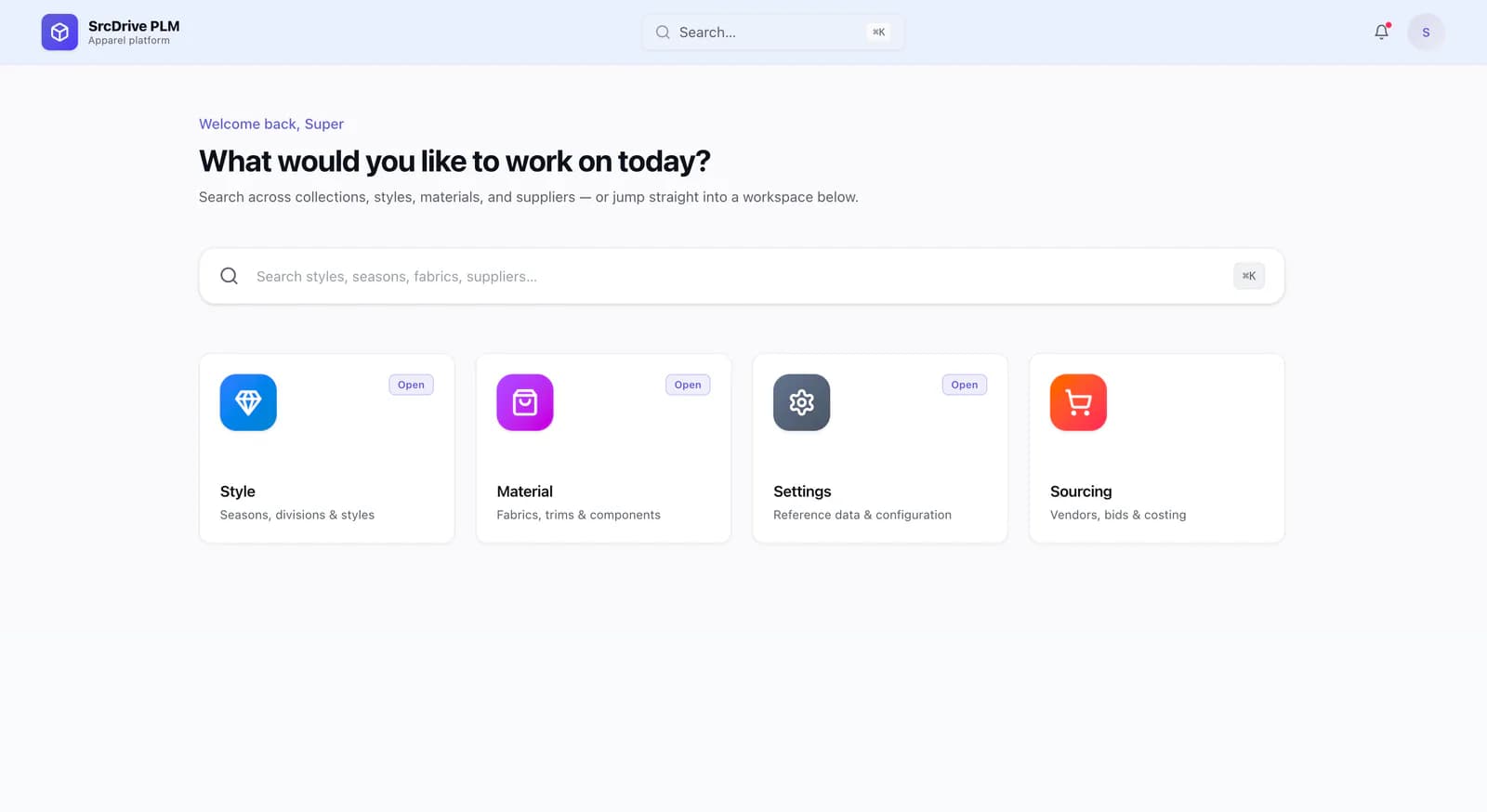
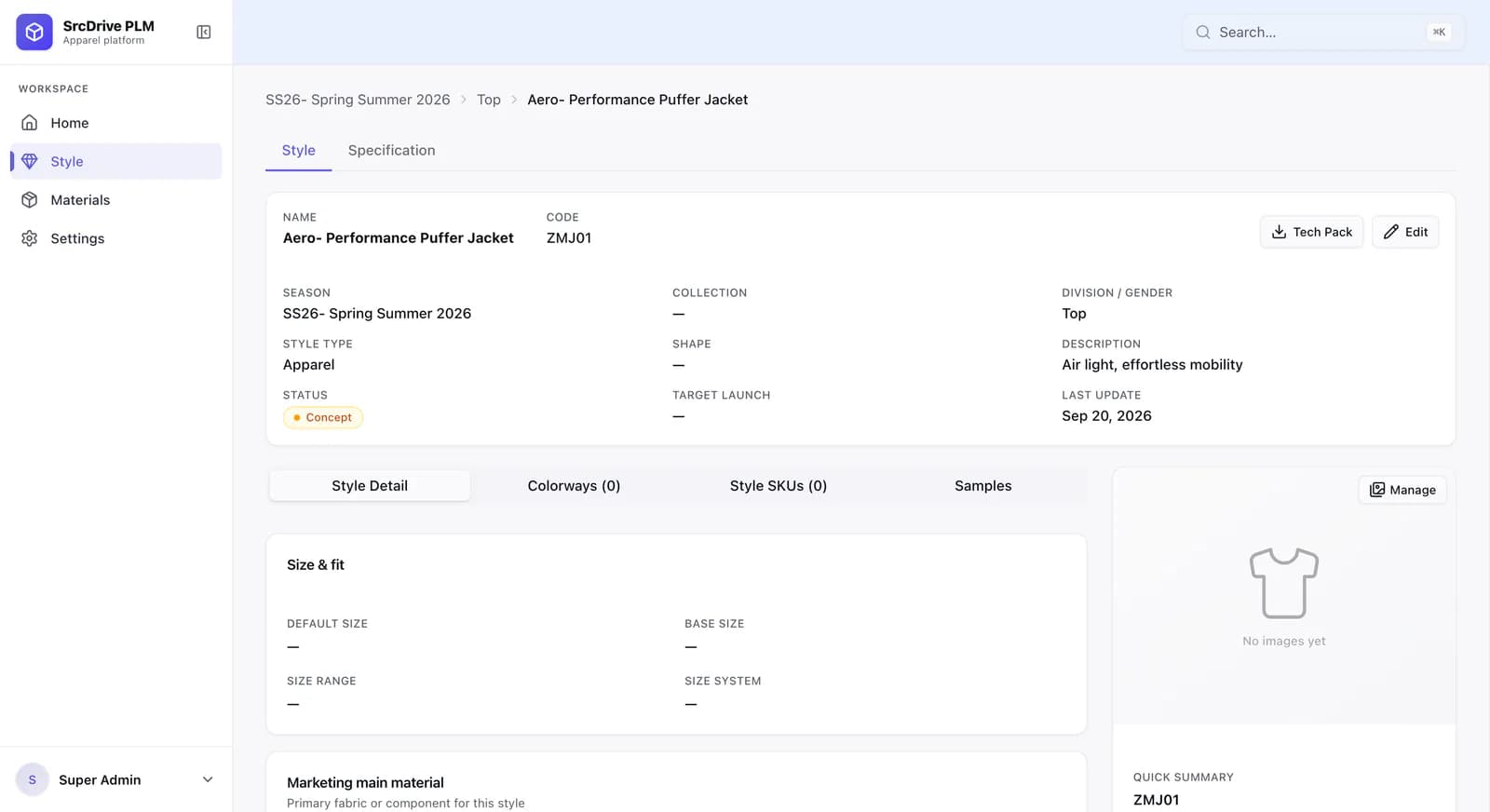
- Season, category and collection hierarchy
- Style, colorway, SKU and size management
- Revision-controlled bills of materials
- Centralised material library
- Fibre-composition tracking and validation
- Colorway-specific material and BOM assignment
- Lab dip and dye lot tracking
- Draft, review, submission and approval workflows
- Tech packs and structured product specifications
- Audit history on product data changes
- Permission-based access control
- Documented API for ERP and supplier integration
In its own words
- product_passport
- chain_of_custody
- season_code
- style_phase
- colorway.sfc
- authority_bom_id
- line_group_id
- composition_text
- lab_dip_status
- EntityHistory
The vocabulary of the running system. If you use software in this category you will recognise it — and if you do not, it is what your team would learn.
Also from SrcDrive
Get in touch
Tell us what your data cannot currently answer.
A short conversation is usually enough to tell whether this is a system problem or a process one. We will say which.